
H₃BO₃. 56.3% B₂O₃. The world's most traded boron compound. Specification-confirmed at origin.
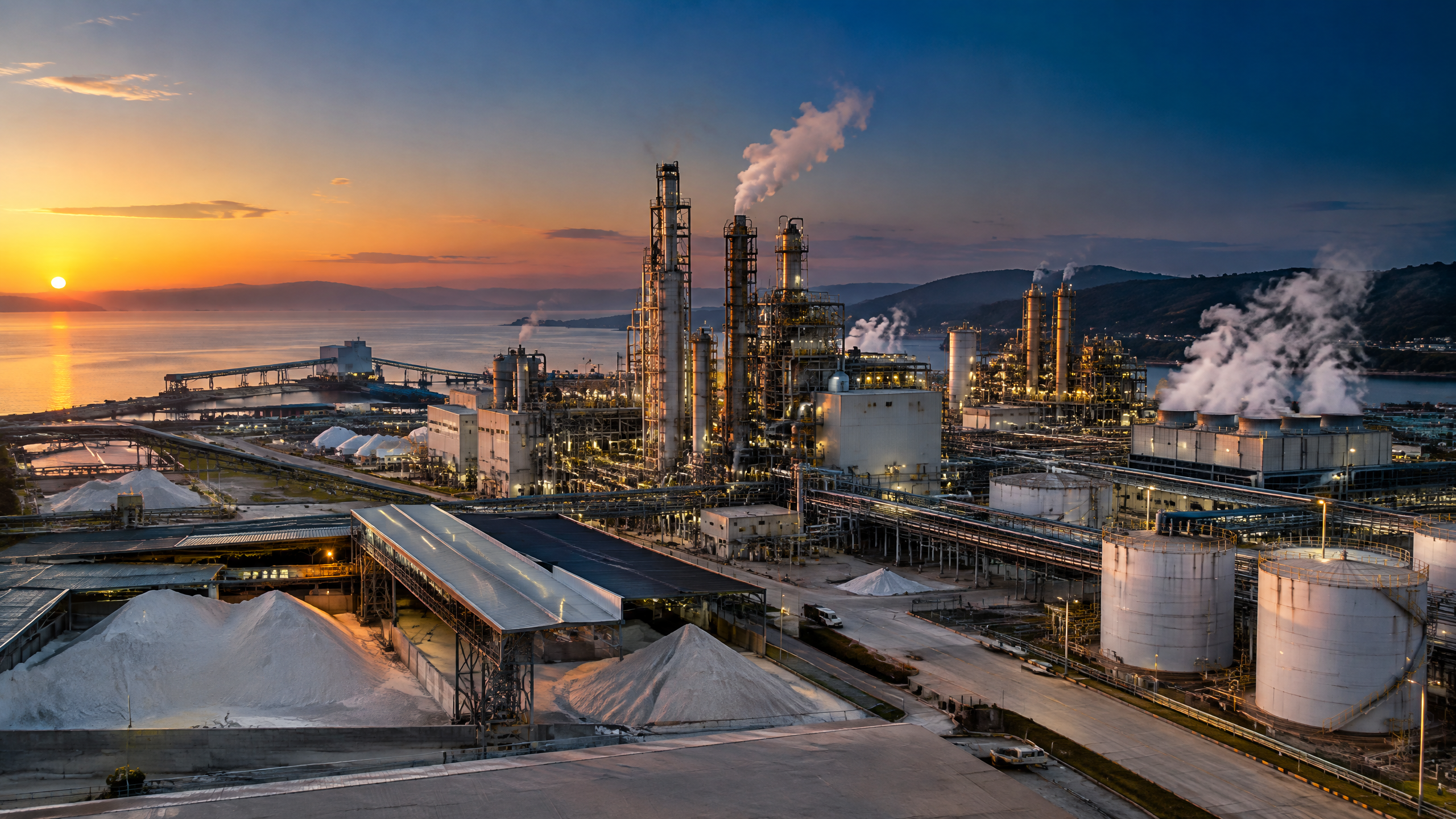
Boric acid is the primary commodity form of boron — produced at Eti Maden's Bandırma and Emet refineries from Turkish colemanite ore via sulfuric acid reaction, and consumed globally in fiberglass insulation glass batches, borosilicate glass compositions, ceramic frit and glaze formulations, halogen-free flame retardants, and agricultural micronutrient programmes. Every shipment includes a production-batch COA with full analytical results — assay, SO₄, Fe, As, Pb, Cl, moisture, and insolubles — confirmed by ICP-OES and titrimetric methods.
Why boric acid specification matters beyond assay purity
Industrial buyers routinely specify boric acid at ≥99.9% H₃BO₃ and consider the specification complete. In practice, the critical quality parameters for most industrial applications are the trace impurities — not the assay. In glass fiber manufacturing, iron (Fe) above 8 ppm causes visible coloration in the finished glass. In pharmaceutical and ophthalmic applications, arsenic (As) and lead (Pb) are regulated at 3 ppm and 5 ppm respectively. In ceramic frit production, insoluble residue above 0.03% causes pinholing in the fired glaze surface. In agricultural foliar spray concentrates, chloride above 100 ppm can cause leaf damage on sensitive crops. We report all six key trace parameters — SO₄, Fe, As, Pb, Cl, and insolubles — on every COA, confirmed by ICP-OES analytical method traceable to the Eti Maden production batch.
Technical grade · Granular grade · Pharmaceutical / food grade
| Parameter | Test method | Technical grade (powder) | Granular grade | USP 43 / BP 2023 pharma | Food-grade (FDA 21 CFR) | Industrial significance |
|---|---|---|---|---|---|---|
| H₃BO₃ assay | ASTM D 3008 · Titrimetric (NaOH) | ≥99.9% | ≥99.9% | ≥99.5% | ≥99.5% | Primary boron delivery — basis for all formulation calculations |
| B₂O₃ equivalent | Calculated from assay | 56.3% | 56.3% | ≥56.1% | ≥56.1% | Design parameter for glass batch and ceramic glaze formulation |
| Sulfate (SO₄) | ICP-OES · ASTM D 4327 | ≤100 ppm | ≤100 ppm | ≤40 ppm | ≤100 ppm | Elevated SO₄ causes glass defects (seeds) in high-temp melts; promotes corrosion in glass tanks |
| Iron (Fe) | ICP-OES · AAS | ≤5 ppm | ≤5 ppm | ≤5 ppm | ≤5 ppm | CRITICAL: Fe above 8 ppm produces visible green/brown coloration in fiberglass and borosilicate glass products |
| Arsenic (As) | ICP-OES · Hydride generation AAS | ≤3 ppm | ≤3 ppm | ≤3 ppm (USP) | ≤3 ppm | Toxic heavy metal — mandatory limit for food contact and pharmaceutical applications |
| Lead (Pb) | ICP-OES | ≤5 ppm | ≤5 ppm | ≤5 ppm | ≤5 ppm | Regulated heavy metal — EU Regulation 2023/2405 (food contact), USP 43 limit |
| Chloride (Cl) | Ion chromatography · Argentometric | ≤50 ppm | ≤50 ppm | ≤20 ppm (USP) | ≤50 ppm | Corrosion risk in glass melts at high temperature; leaf toxicity in foliar spray concentrates above 100 ppm |
| Water (H₂O) · Moisture | Karl Fischer titration | ≤0.3% | ≤0.3% | ≤0.5% | ≤0.3% | Excess moisture causes caking during storage and affects weight-based dosing accuracy |
| Insolubles (water-insoluble matter) | Filtration through 100μm membrane | ≤0.02% | ≤0.02% | ≤0.01% | ≤0.02% | CRITICAL for ceramic glazes: insolubles above 0.05% cause pinholing and crawling defects in fired glaze |
| Particle size (technical powder) | Laser diffraction · ISO 13320 | d50: 30–100 μm · Powder form | N/A | d90 ≤100 μm | d90 ≤100 μm | Affects dissolution rate and dust generation during batch preparation |
| Particle size (granular grade) | Sieve analysis · ISO 3310 | N/A | ≥90% retained on 0.5mm sieve · ≥98% on 0.1mm | N/A | N/A | Granular grade preferred where dust control and free-flowing handling are required (glass batch, NPK blending) |
| Bulk density | ISO 3923 | ~900–950 kg/m³ | ~950–1,050 kg/m³ | ~900 kg/m³ | ~950 kg/m³ | Required for storage vessel and silo sizing; affects FCL packing density |
| Packaging and logistics specification | ||||||
| Standard packaging | — | 25 kg PP woven bags · HDPE inner liner | 25 kg PP woven bags · 1,000 kg FIBC big bags | 25 kg double PE-lined bags | 25 kg double PE-lined · Food-contact compliant inner | Sealed against moisture ingress · Stacked on EUR pallets · Stretch-wrapped per FCL |
| FCL loading capacity | — | ~20 MT per 20' FCL (25 kg bags palletised) | ~22 MT per 20' FCL (25 kg bags) · ~24 MT (big bags) | ~20 MT per 20' FCL | ~20 MT per 20' FCL | FCL from Bandırma Port · LCL consolidation available Bandırma / Istanbul |
| Preferred export Incoterms | — | FOB Bandırma Port · FOB Mersin Port · CFR/CIF any world port | Freight quotation available on request for any destination | |||
| Industry / application | B₂O₃ function in product | Typical B₂O₃ % in formulation | Why boric acid specifically | Grade required | Governing standard |
|---|---|---|---|---|---|
| Fiberglass insulation (E-glass) | Lowers glass melt viscosity; reduces CTE; improves chemical durability; enables fibre-drawing at 1,200°C | 6–10% B₂O₃ in glass batch | Granular grade flows without dusting in continuous glass tank batch systems. B₂O₃ reduces fibre brittleness and improves thermal insulation performance (lower CTE of glass). | Granular — 1,000 kg FIBC preferred | ISO 9820 (fibre properties) · ASTM C 167 |
| Borosilicate glass (Pyrex-type) | Provides boron modifier oxide; reduces CTE to 3.3×10⁻⁶ /K (vs 8.5 for soda-lime); increases chemical durability and thermal shock resistance | 10–15% B₂O₃ | Precise B₂O₃ content control (±0.2%) is required for CTE specification. Technical powder allows accurate weighing. | Technical powder · Low Fe (≤3 ppm) | ISO 3585 · DIN 12116 |
| Electronic display glass (TFT/LCD/OLED substrates) | Flat panel glass composition requires B₂O₃ for refractive index control and low thermal expansion. Must be colourless — Fe specification is critical. | 10–14% B₂O₃ | Fe content must be ≤3 ppm to prevent glass coloration visible in display backlight transmission. Technical powder grade with Fe ICP-OES confirmation. | Technical powder · Fe ≤3 ppm (specify) | IEC 60068-2-1 glass flatness · Display glass standards |
| Ceramic frits and glazes | Flux action — lowers frit melting temperature by 100–200°C; improves gloss, surface tension, and wetting of glaze on ceramic substrate | 8–25% B₂O₃ in frit batch | Boric acid dissolves completely during frit fusion — no residual mineral structure. Preferred over colemanite where full dissolution is required. | Technical powder · Insolubles ≤0.01% | EN 14411 (ceramic tiles) · ISO 10545 |
| Halogen-free flame retardants (polymers, textiles) | Promotes intumescent char formation at 200–400°C; radical scavenging in flame zone; dehydration reaction absorbs heat | 5–15% by weight in FR compound | Boric acid is the primary boron source in zinc borate and borate-phosphate FR systems. Enables EU REACH compliance as halogen-free (replaces TBBPA, HBCD). | Technical powder · Fine grade preferred | EU RoHS Directive 2011/65/EU · REACH SVHC compliance |
| Agricultural boron micronutrient (soil) | Boron micronutrient — essential for cell wall synthesis, pollen germination, and fruit set. Deficiency causes hollow heart, die-back, and reduced yield. | 0.5–2 ppm B in soil (optimal range) | Boric acid dissolved in irrigation water provides rapid-availability boron for acute deficiency correction. Most water-soluble borate (57.2 g/L at 20°C) after Solubor. | Technical grade · Water-soluble | EN 16048 (plant analysis) · FAO crop standards |
| Pharmaceutical (ophthalmic solutions) | pH buffer 5.0–9.0 (borate buffer system); mild antiseptic; isotonic adjustment agent in eye drop and contact lens solution formulations | 1.0–1.9% w/v in ophthalmic solution | USP and BP monograph compliance required. Boric acid ophthalmic grade (As ≤3 ppm, Pb ≤5 ppm, residue on ignition ≤0.05%) is the pharmacopoeial standard. | USP 43 / BP 2023 pharma grade | USP 43 monograph · Ph. Eur. 10th Ed. · ICH Q6A |
| Nuclear neutron shielding and control | ¹⁰B isotope has neutron capture cross-section of 3,840 barns — highest of any stable nuclide used commercially. Absorbs thermal neutrons before they reach shielded area. | Per reactor/shield specification (variable) | Boric acid dissolved in reactor coolant water controls reactivity in pressurised water reactors (PWR). Solid boric acid in neutron shielding concrete (borated concrete). | Technical grade · ¹⁰B natural abundance 19.9% (isotopically enriched on request) | IAEA nuclear safety standards · ASTM C 1014 |
Every applicable standard — confirmed per shipment where required
- ASTM D3008 — Boric acid analysis
- ISO 6353-3 — Reagent-grade boric acid
- ICP-OES trace metals (all elements)
- Karl Fischer — moisture determination
- ISO 3923 — Bulk density
- ISO 13320 — Particle size (laser)
- USP 43 — Boric Acid monograph
- BP 2023 — Boric Acid monograph
- Ph. Eur. 10th Ed. — Acidum boricum
- FCC (Food Chemicals Codex)
- Kosher certification (batch basis)
- ICH Q6A — specification guidance
- FDA 21 CFR 172.886 — food-grade
- EU Regulation 1999/21/EC
- REACH Reg. 1907/2006 — registered
- CLP Regulation 1272/2008 — labelled
- RoHS 2011/65/EU — compliant
- SVHC declaration available
- UN 3077 (granular ≥5mm) — Class 9
- Technical powder — non-hazmat ADR
- SDS (Safety Data Sheet) — EU GHS
- IMSBC (ocean bulk) — Group C
- IMDG — not regulated (powder form)
- Storage: cool, dry, away from alkalis
Boric acid supply metrics
Specify grade (technical or granular), quantity, packaging, and destination port. We respond in 4 hours.
Technical powder for glass, ceramic, pharmaceutical, and high-precision agricultural applications. Granular for NPK blending, glass batch batch systems, and dust-controlled handling. Provide Fe specification requirement if critical for your application.