

The ceramic glaze and frit industry's boron mineral of choice. 1.8 g/L solubility. Does not pre-dissolve. Ever.
Ground colemanite (Ca₂B₆O₁₁·5H₂O) does not dissolve in glaze suspension water. That single physical property — water solubility of only 1.8 g/L at 20°C — makes it the standard boron source for ceramic frit and glaze production worldwide. Where boric acid would dissolve into the water phase and migrate non-uniformly during drying, colemanite remains as a mineral particle and releases its B₂O₃ only at frit furnace or kiln temperatures above 800°C. The result is a homogeneous, reproducible fired glaze — every batch, every tile, every firing cycle.
The solubility problem that makes boric acid technically unsuitable for most ceramic glaze applications
Ceramic glaze is prepared as a suspension of minerals in water — milled and mixed to a specific gravity of approximately 1.45–1.65 g/cm³ and applied to the green or biscuit body by dipping, spraying, or curtain coating before firing. Boric acid, with its solubility of 57.2 g/L at 20°C, dissolves rapidly and completely into the glaze water phase. During the subsequent drying stage, boron ions migrate with the evaporating water toward the drying glaze surface, concentrating in the outer layer rather than distributing uniformly through the glaze thickness. When fired, this creates a boron-concentration gradient — a B₂O₃-rich skin at the top and a boron-deficient layer below — that produces differential thermal expansion, resulting in glaze crawling, pinholing, and surface defects. Colemanite at 1.8 g/L solubility does not dissolve into the glaze water. It remains as a mineral particle uniformly dispersed throughout the glaze suspension, and releases its B₂O₃ only at frit furnace temperatures above 800°C — when the glass melt itself is the medium. The B₂O₃ distribution in the fired glaze is determined by how the mineral particles are distributed in the unfired glaze — and that distribution is controlled by the glaze miller, not by water chemistry. That is why colemanite is specified in ceramic glazes and boric acid is not.
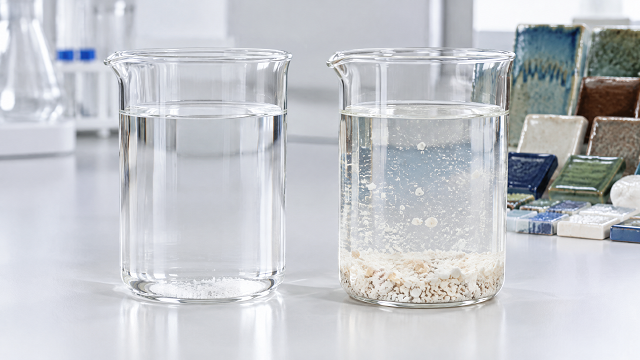
97% lower than boric acid (57.2 g/L). Colemanite does not dissolve in the glaze water phase — stays as a mineral particle until fired above 800°C.
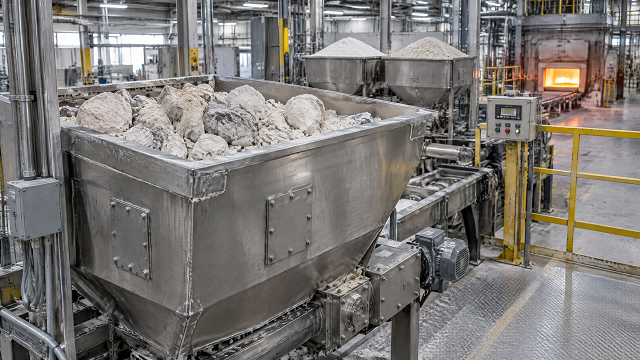
Colemanite provides both boron oxide and calcium oxide to the glass batch — two essential glaze modifiers from one mineral input. Boric acid provides boron only, requiring separate calcium carbonate or wollastonite addition.
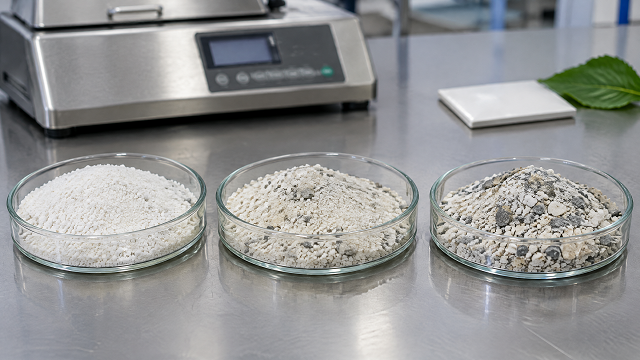
Ceramic grade: Fe₂O₃ ≤0.12%, SiO₂ ≤4.0% — for colour-critical white and light-colour glazes. Standard and agricultural grades have wider impurity tolerances.
Ceramic grade · Standard grade · Agricultural grade — every parameter confirmed per production batch
| Parameter | Test method | Ceramic grade | Standard grade | Agricultural grade | Industrial significance |
|---|---|---|---|---|---|
| B₂O₃ content |
ICP-OES · ASTM D 3008
|
40.0–42.0%
|
38.0–42.0% | 38.0–42.0% | Ceramic grade specified at upper range for consistent frit boron loading. Agricultural grade: full natural variation range. |
| CaO content |
ICP-OES · XRF
|
26.0–28.0% | 25.0–28.0% | 25.0–28.0% | CaO is a glass network modifier — provides additional calcia to ceramic frit alongside B₂O₃. Dual flux advantage over boric acid (boron only). |
| SiO₂ (silica) |
ICP-OES · XRF gravimetric
|
≤4.0%
|
≤6.0% | ≤8.0% |
CRITICAL for ceramic grade: SiO₂ above 4% alters frit composition, affects glaze viscosity and surface tension, and must be accounted for in glaze recipe calculations — often not provided by standard-grade suppliers.
|
| Fe₂O₃ (iron oxide) |
ICP-OES
|
≤0.12%
|
≤0.15% | ≤0.20% |
CRITICAL for ceramic grade: Fe₂O₃ as low as 0.10% produces a visible cream/yellow tint in white glaze against a white body. Ceramic grade Fe₂O₃ ≤0.12% is essential for porcelain, tableware, and white wall tile production.
|
| Al₂O₃ (alumina) |
ICP-OES · XRF
|
≤1.5% | ≤2.0% | ≤2.5% | Al₂O₃ increases fired glaze viscosity and extends the firing range. Must be included in glaze calculation (Seger formula) to avoid underfiring or stiff glaze surface. |
| MgO |
ICP-OES
|
≤1.0% | ≤1.5% | ≤2.0% | Minor flux contributing to glass network modifier balance. Low levels beneficial for glaze mattness control in matte glaze formulations. |
| Na₂O content |
ICP-OES · Flame photometry
|
≤0.3%
|
≤0.5% | ≤0.8% | Very low Na₂O — the critical advantage over borax in low-alkali glaze formulations. High-alkali glazes have lower acid resistance and higher crazing risk. Colemanite allows formulation of high-boron, low-alkali glazes impossible with borax. |
| Loss on Ignition (LOI) at 1,000°C |
Gravimetric · ISO 3262
|
22–26% | 22–28% | 20–28% | LOI represents crystal water and CO₂ release during firing. Must be accounted for in batch calculations — the effective mineral load per tonne decreases by LOI% during frit furnace firing. |
| Water solubility at 20°C |
Gravimetric dissolution test
|
~1.8 g/L
|
~1.8 g/L
|
~1.8 g/L
|
DEFINING CHARACTERISTIC — the same for all grades. Does not vary with chemical grade. This property — the lowest solubility of all standard boron products — is the fundamental reason colemanite is preferred in ceramic glazes over all other boron minerals.
|
| Moisture (surface) |
Karl Fischer · EN 12432
|
≤0.5% | ≤1.0% | ≤1.5% | Surface moisture from grinding — affects handling flowability and weight measurement accuracy. Relevant for large-volume batch operations. |
| Particle size specifications — three product grades | |||||
| Ceramic fine grade |
Laser diffraction · ISO 13320
|
D50: 10–20 μm · D90: ≤45 μm | N/A | N/A | Fine particle size improves reactivity in frit furnace and distribution uniformity in ceramic glaze suspension. Required for high-quality frit production with consistent B₂O₃ input. |
| Standard ceramic ground |
Sieve analysis · ISO 3310
|
D50: 25–50 μm · D90: ≤100 μm | D50: 30–60 μm · D90: ≤150 μm | N/A | Standard grind for most frit and glaze applications. Balances reactivity with dust control during handling. |
| Agricultural coarse grade |
Sieve analysis · ISO 3310
|
N/A | N/A | D90: ≤250 μm (coarse) · D90: ≤500 μm (extra coarse) | Coarser grade for direct soil broadcast application — fine particles wind-drift during spreading. D90 ≤250 μm is optimal balance of surface area for dissolution and broadcast retention on soil. |
| Packaging and logistics specification | |||||
| Standard packaging | — | 25 kg PP bags · Ceramic fine: double PE-lined · 500 kg FIBC | 25 kg PP bags · 1,000 kg FIBC | 25 kg PP bags · 1,000 kg FIBC · Bulk (road tanker) available | FIBC big bags preferred for frit manufacturers with pneumatic unloading systems. 25 kg bags for smaller ceramic producers and laboratory use. |
| FCL loading capacity | — | ~20–22 MT / 20' FCL (25 kg bags) | ~22 MT / 20' FCL | ~22–24 MT / 20' FCL (FIBC) | FOB Bandırma or Mersin Port · CIF destination available · Transit time to Mediterranean 3–5 days · N. Europe 8–12 days |
Six industries · Each with the specific property utilised and why colemanite outperforms alternatives
| Industry / Application | Property utilised | Why colemanite — not boric acid or borax | Performance parameter delivered | Grade specified | Governing standard |
|---|---|---|---|---|---|
| Ceramic floor & wall tile — frit production | B₂O₃ flux (lowers frit melting point) · CaO glass modifier · Low solubility prevents pre-dissolution | Boric acid dissolves into glaze water → boron migrates to surface during drying → non-uniform distribution → pinholing and crawling defects on fired tile. Colemanite stays as solid particle → uniform B₂O₃ distribution in frit melt → consistent glaze properties batch to batch. | Frit fusion temperature reduced 100–200°C · Surface gloss improved · | Thermal expansion coefficient controllable · Crazing resistance improved Ceramic grade · Fe₂O₃ ≤0.12% · D50 10–20 μm | EN 14411 · ISO 10545 series |
| Sanitaryware (WC, basin, bath) — glaze | B₂O₃ flux · CaO · Very low Na₂O (≤0.3%) for acid-resistant low-alkali glaze | Sanitaryware glaze must withstand acidic cleaning agents (citric acid, bleach) without etching or dulling. High-borax glazes have elevated Na₂O that reduces acid resistance below EN 14688 requirements. Colemanite provides boron without sodium, allowing formulation of acid-resistant boron glazes. | Acid resistance Class HA (ISO 10545-13) · Thermal shock resistance ΔT ≥145°C (ISO 10545-9) · White index ≥80 (CIE L*a*b*) | Ceramic grade · Fe₂O₃ ≤0.12% · SiO₂ ≤4.0% | EN 14688 · ISO 10545-9 · ISO 10545-13 |
| Tableware & fine porcelain — transparent glaze | B₂O₃ flux · CaO · Low Fe₂O₃ (≤0.12%) for white colour purity | Even 0.10% Fe₂O₃ produces a visible cream/yellow cast in a transparent glaze applied over a white porcelain body — visible to the consumer under typical dining lighting. Ceramic grade colemanite (Fe₂O₃ ≤0.12%) prevents this discolouration. Standard-grade colemanite at Fe₂O₃ ≤0.15% is not acceptable for fine tableware. | Whiteness index ≥82 · No visible colour cast over white body · Gloss retention after dishwasher testing per EN ISO 1219 | Ceramic grade only · Fe₂O₃ ≤0.12% · LOI confirmed | EN ISO 1219 · ISO 10545 |
| E-glass fiber insulation (glass wool) | B₂O₃ reduces melt viscosity for fibre drawing · CaO glass network modifier | E-glass composition (ASTM D 578): SiO₂ 54.3%, Al₂O₃ 14.0%, CaO 22.0%, B₂O₃ 6.9%, MgO 1.7%. Colemanite provides both B₂O₃ (6.9% target) and part of the CaO (22.0% target) from a single mineral — reducing batch raw material count versus separate boric acid and limestone inputs. Also eliminates batch moisture sensitivity from boric acid dissolution. | Fibre drawing viscosity: 1,000 poise at working temperature · CTE 5.9×10⁻⁶ /K · Modulus 72 GPa (ASTM D 578) | Standard grade · SiO₂ within E-glass batch balance | ASTM D 578 · ISO 2078 · EN 14303 |
| Direct agricultural soil — slow-release boron | Very low water solubility (1.8 g/L) → controlled season-long boron release as soil moisture dissolves mineral surface | At 1.8 g/L solubility, colemanite releases boron gradually as soil moisture contacts fresh mineral surface — providing 4–6 months of availability from a single broadcast application. Boric acid (57.2 g/L) or Solubor (97 g/L) would release all boron within 2–4 weeks following rainfall, creating boron toxicity risk in sensitive crops and depleting the soil boron supply before the critical growth stage. | Application rate: 2–5 kg B/ha · Availability period: 4–6 months · Target soil B: 0.5–2.0 ppm (extractable) | Agricultural grade · D90 ≤250 μm · Fe₂O₃ ≤0.20% | EN 16047 · FAO/WHO boron crop recommendations |
| Refractory castables — calcium aluminate cement modifier | B₂O₃ retards setting time of calcium aluminate cements · CaO compatible with cement chemistry | In calcium aluminate refractory castables, minor colemanite additions (0.5–2.0%) extend working time (set retardation) and improve high-temperature strength by modifying the hydrogarnet phase formation during curing. The CaO content is chemically compatible with aluminous cement — no adverse secondary phase formation. Colemanite's low solubility prevents premature B release during mixing. | Setting time extended 1–4 hours at 0.5–1.5% addition · Cold crushing strength improved at 900°C · Creep resistance at 1,300°C | Standard grade · SiO₂ within castable batch limit | ASTM C 860 · EN 14647 · ASTM C 401 |
Every document your quality, procurement, and regulatory teams require
B₂O₃, CaO, SiO₂, Fe₂O₃, Al₂O₃, MgO, Na₂O, LOI, moisture, particle size — all per production batch. Traceable to Eti Maden batch number and production date.
ATR for EU preferential tariff · EUR.1 movement certificate · Form A (GSP) for developing country exports · Standard commercial CoO for all other markets.
EN 16047 boron availability data · Total and water-soluble B₂O₃ · Particle size distribution · REACH compliance for fertilizer product registration in EU, Turkey, and Asian markets.
Full oxide composition (Seger formula basis) · LOI confirmed · Particle size distribution curve · Solubility data · Recommended addition rates for frit and glaze formulations.
Ground colemanite — key supply metrics
Specify grade (ceramic/standard/agricultural), particle size, and annual volume. Quote in 4 hours.
Ceramic grade (Fe₂O₃ ≤0.12%, SiO₂ ≤4.0%) for colour-critical tile and sanitaryware glazes. Standard grade for E-glass batch and general frits. Agricultural grade for soil broadcast. Specify D50 or D90 particle size requirement and preferred packaging (25 kg bags or FIBC).