Security screening systems matched to your facility type and threat profile —
with tender dossier support.
X-ray baggage inspection, walk-through metal detectors, vehicle under-body scanning, explosive trace detection, full body scanners, and CCTV surveillance — specified by application matrix for airports, border crossings, government buildings, oil facilities, and commercial premises. Tender documentation support included for public procurement bids.
Application matrix. Tender support. Certification documentation. The three requirements of institutional security procurement.
Airport security requirements differ fundamentally from border crossing, oil facility, and government building requirements — different threats, different throughput rates, different regulatory frameworks, different certification requirements. We issue an application matrix matching each security system type to your facility category before the quotation, confirming what is mandatory, what is recommended, and what is optional for the threat profile.
Security equipment in the Middle East, Africa, and Central Asia is frequently procured through public tender processes requiring formal technical documentation. We prepare the compliance matrix, technical datasheet submissions, certificate portfolio, and company qualification documentation for the tender submission — reducing the administrative burden on the buyer's procurement team.
For airport security equipment, ECAC Doc 30 approval status (EU) and TSA approval (USA) are confirmed before the quotation. National civil aviation authority approval requirements for the destination country are verified at the specification stage — not discovered after the equipment is ordered.
Security equipment sales to certain destination countries require End-User Certificates (EUC), Ministry of Interior approval, or export licence from Turkish export control authority (Savunma Sanayii Başkanlığı for defence-grade items). We facilitate the complete EUC and export documentation process as part of the supply service.
Six core security system categories — each with performance specifications, certification requirements, and facility applications confirmed at quotation.
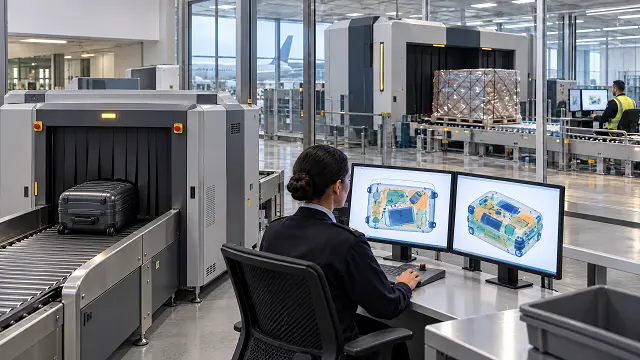
System 01 — X-Ray Baggage & Cargo Inspection
Dual-energy and CT-based X-ray systems for cabin baggage, hold baggage, parcel, and cargo inspection.
Single-energy X-ray for cost-effective parcel and access control baggage screening; dual-energy X-ray for organic/inorganic material discrimination and improved threat detection capability; CT-based EDS (Explosive Detection System) to ECAC Standard 3 for aviation hold baggage screening where explosives detection is the primary requirement. Tunnel sizes from 400×300 mm (cabin baggage) to 1,000×1,000 mm (hold baggage) to 1,800×1,800 mm (pallet cargo and vehicle inspection). Radiation dose per pass: ≤1 μSv at tunnel apertures per IEC 62463 — confirmed on radiation safety certificate. Operator monitor with dual-screen dual-view display; automatic threat recognition (ATR) software for automatic alarm on prohibited items; remote review workstation option for central image analysis.
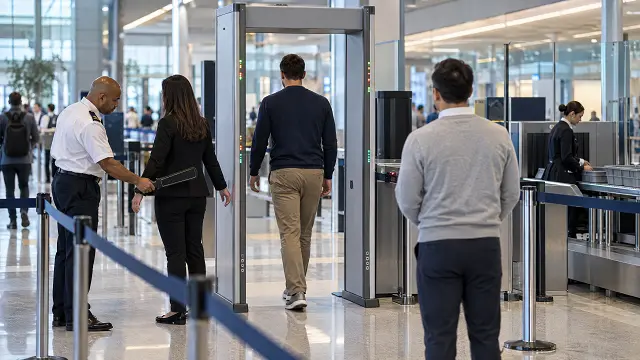
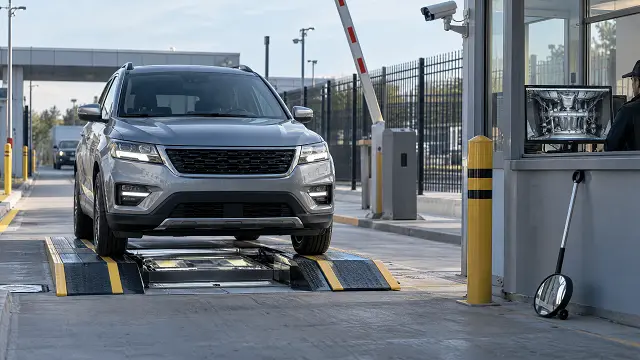
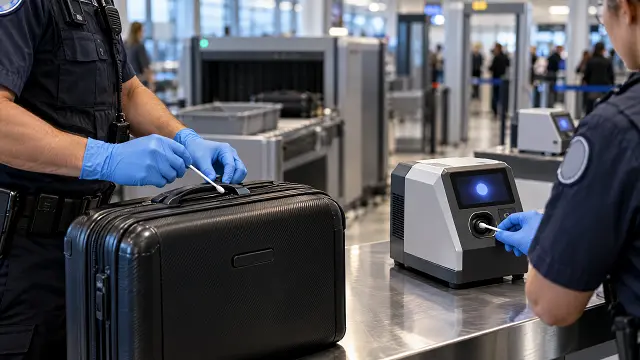
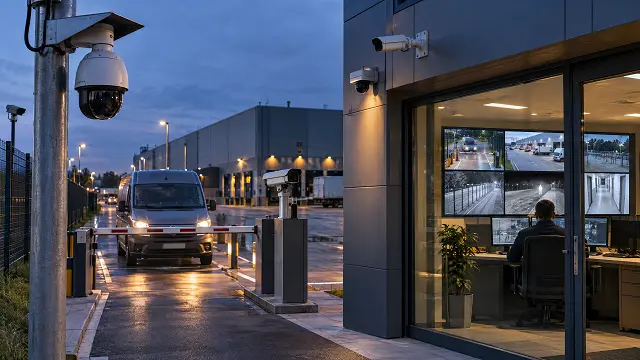
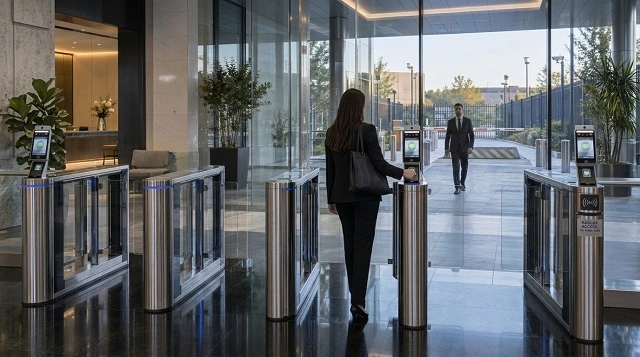
Security system requirements by facility type — mandatory, recommended, and optional for each.
| System | Airport | Border Crossing | Govt Building | O&G Facility | Hotel / Mall | Prison |
|---|---|---|---|---|---|---|
| X-Ray Baggage | ✓ Mandatory | OPT Parcel | ✓ Mandatory | OPT | ✓ Recommended | ✓ Mandatory |
| CT-EDS Hold Baggage | ✓ Mandatory | — | — | — | — | — |
| WTMD / HHMD | ✓ Mandatory | ✓ Mandatory | ✓ Mandatory | ✓ Recommended | ✓ Recommended | ✓ Mandatory |
| UVSS Vehicle | OPT | ✓ Mandatory | ✓ Recommended | ✓ Mandatory | OPT | ✓ Mandatory |
| ETD Explosive Trace | ✓ Mandatory | ✓ Recommended | OPT | — | — | — |
| Full Body Scanner | ✓ Recommended | OPT | OPT VIP | — | — | OPT |
| CCTV / IP Video | ✓ Mandatory | ✓ Mandatory | ✓ Mandatory | ✓ Mandatory | ✓ Mandatory | ✓ Mandatory |
| ANPR (LPR) | ✓ Recommended | ✓ Mandatory | ✓ Recommended | ✓ Recommended | OPT | — |
| Turnstile / Barrier | ✓ Mandatory | ✓ Mandatory | ✓ Mandatory | ✓ Mandatory | ✓ Recommended | ✓ Mandatory |
| Perimeter Intrusion | OPT | ✓ Recommended | OPT | ✓ Mandatory | OPT | ✓ Mandatory |
Three security procurement requirements that institutional buyers in the Middle East and Africa prioritise — and that commodity equipment suppliers cannot provide.
The most common security procurement error is specifying security equipment without starting from the threat profile and the regulatory framework for the facility type. An airport security checkpoint has mandatory ECAC-approved equipment requirements, specific lane configuration, and operator training standards — which a generic security equipment catalogue does not tell you. A border crossing requires UVSS for every lane, ANPR for vehicle identification, and staff access control that a hotel security specification does not include. Before we issue a quotation for any security system, we issue a one-page application matrix for the specific facility type — stating what is mandatory, what is recommended, and what is optional — and ask the client to confirm the facility category and the applicable national regulatory framework. This eliminates the most expensive security procurement error: ordering the wrong system for the facility.
Public security procurement in Iraq, Nigeria, Kazakhstan, Algeria, and most other countries in our core markets follows a formal tender process — typically through a government ministry, national security authority, or infrastructure project owner. The tender requires: a compliance matrix showing each technical specification requirement and the proposed equipment's compliance response; technical datasheets in the specified format (sometimes the tender format, sometimes the supplier's format); certificate copies (CE, ECAC, ECAC approval letter, IEC); company qualification documents (company profile, ISO certificates, bank letter of creditworthiness, past supply references for similar equipment); and sometimes an end-user declaration or factory visit invitation. Global Trading prepares the complete tender dossier for security system tenders — reducing the workload on the client's procurement team and improving the quality of the bid submission.
ECAC (European Civil Aviation Conference) maintains the Common Evaluation Process (CEP) for aviation security equipment — an approved products list of X-ray systems, ETD units, WTMD, and full body scanners that have been independently tested to ECAC Doc 30 standards. EU member states' civil aviation authorities, and most non-EU aviation authorities in the ECAC region, require only ECAC-approved equipment for airport security screening. Many Middle East and African civil aviation authorities follow ECAC standards. If the X-ray system specified for an airport hold baggage hall is not on the current ECAC approved products list for Standard 3 EDS, it cannot legally be used in that application — regardless of the manufacturer's claims. We check the current ECAC approved products list and the destination country's national civil aviation authority requirements before the quotation is issued. This prevents the most costly airport security procurement failure: equipment that arrives at the airport and cannot be commissioned because it is not approved.
Six facility categories — security system configuration, certification, and regulatory framework matched to each.
Mandatory ECAC-approved equipment for hold baggage (EDS Standard 3 CT-based), cabin baggage (dual-energy X-ray), and passenger (WTMD, ETD, FBS). Checkpoint lane configuration to ECAC Doc 30. Operator mandatory training requirements. National CAA inspection and commissioning acceptance. Regulatory framework: EU 2015/1998, ICAO Annex 17, national CAA standards.
UVSS for vehicle undercarriage at every vehicle lane; cargo X-ray (fixed portal or van-mounted relocatable) for selective vehicle and cargo inspection; WTMD and HHMD for all pedestrian passages; ANPR for vehicle identification database matching; facial recognition option for traveller identification. Integration with customs and immigration database systems. Regulatory framework: national border control authority.
Dual-energy X-ray for all visitor access points; WTMD for all pedestrian entry lanes; UVSS for vehicle entry; CCTV internal and external with AI analytics; access control (card/biometric) for staff areas; bollards and vehicle barriers at perimeter entry points; panic alarm system. For embassies: host country security authority consultation required for perimeter security requirements.
UVSS at all vehicle entry gates; WTMD and HHMD at pedestrian entry; ATEX-rated CCTV (Zone 1/Zone 2) for process area surveillance; access control (card + PIN) for secure areas with zonal access levels; perimeter surveillance (thermal cameras, ground radar, fence sensors) for large facility perimeters. Intrinsically safe or flameproof ATEX rating required for all cameras and access control equipment in classified areas.
Dual-energy X-ray at main guest/visitor entry; WTMD for all entry lanes; CCTV (lobby, parking, service areas) with VMS platform; access control (key card) for guest floors and service areas; vehicle barrier at main driveway entry. For hotels in high-threat environments: UVSS added for vehicle entry inspection; perimeter barriers for vehicle-borne IED (VBIED) protection. Soft-target threat assessment before system design.
Full body scanner (millimetre-wave AIT) for all personnel entering secure zones — detecting concealed prohibited items including non-metallic objects that WTMD cannot detect; X-ray for all items brought into the facility; CCTV throughout with 24/7 recording; full-height turnstiles (anti-climb, anti-tailgating) at all zone boundaries; intercom and cell door control system. Visitor entry separate from staff entry with different screening levels.
Questions security procurement managers ask before selecting a security system supplier.
What's included with every security quotation
Describe your facility type and security requirement. Application matrix and quotation within 48 hours.
Facility type (airport / border / government / O&G / hotel / prison) · country and city · number of entry lanes (vehicle and pedestrian) · approximate daily throughput · applicable regulatory framework (ECAC, national CAA, Ministry of Interior) · tender requirement (yes/no) · budget range. We issue the application matrix and quotation together.