
Produits · Actionneurs et systèmes de contrôle

Actionnez chaque vanne figurant sur votre schéma tuyauterie et instrumentation (P&ID). Dimensionnement basé sur le couple. Sécurité positive (fail-safe) confirmée. Batterie pour système d'arrêt d'urgence (ESD) calculée lors de l'établissement du devis.

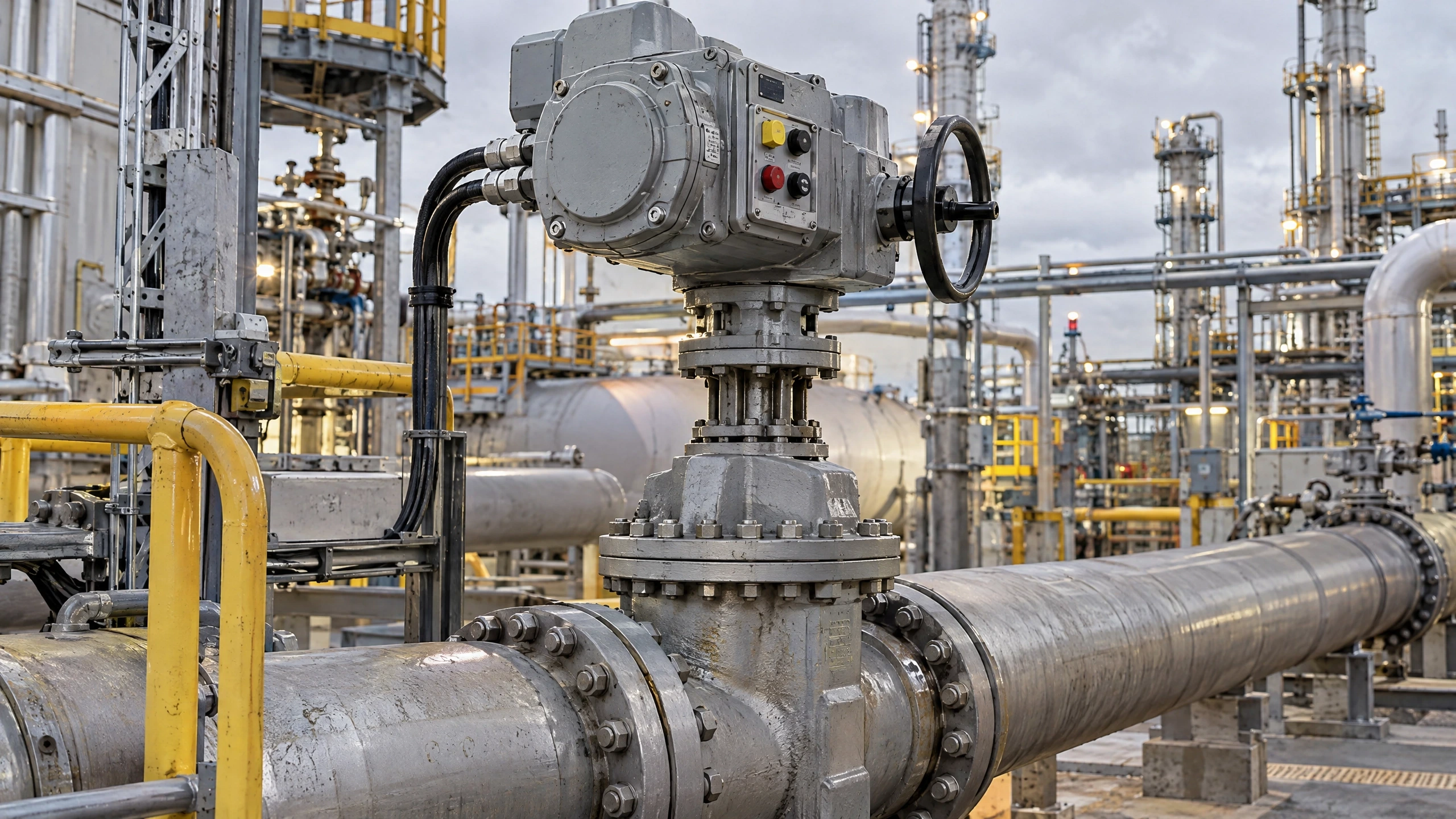
Actionneurs électriques, pneumatiques, hydrauliques et oléopneumatiques (gaz-huile) équipés de positionneurs numériques — conformes à la directive ATEX (zone 1) et aux niveaux SIL 2/3 selon la norme CEI 61511 — adaptés à tout type de vanne et à toute exigence de sécurité (mise en position de sécurité). Le calcul du couple et le dimensionnement des batteries pour systèmes d'arrêt d'urgence (ESD) sont fournis dès l'établissement du devis, avant même la passation de votre commande.

Soumettre la liste des vannes Formulaire de demande de dimensionnement Options certifiées ATEX
NORMES ET HOMOLOGATIONS
ISO 5210 ISO 5211 EN 15714 IEC 60529 IP ATEX 2014/34/UE IECEx IEC 61511 SIL HART 7 FF H1 Profibus PA NEMA 4X
Pourquoi choisir Global Trading pour vos actionneurs ?

Le détail technique qui dissocie l’approvisionnement en actionneurs de la sélection des actionneurs.

Dimensionnement du couple — Fourni avec chaque devis


Fiche technique des couples de la vanne, conditions de fonctionnement les plus défavorables (ΔP maximal avec une alimentation minimale), coefficient de sécurité appliqué (généralement de 1,25 à 1,5 fois) et couple de sortie de l’actionneur confirmé par écrit — tout cela doit être établi avant l’émission de votre bon de commande. Pas une fois que l’actionneur est arrivé et qu’il s’avère incapable de manœuvrer la vanne.

Calcul de batterie pour système de secours (ESD) — Standard pour les commandes incluant une batterie de secours

Pour les actionneurs électriques de sécurité (ESD) équipés d’une batterie de secours, nous calculons la capacité de batterie nécessaire pour assurer le nombre spécifié de manœuvres sur toute la course, à la température ambiante minimale. Les caractéristiques de la batterie sont confirmées lors de l’établissement du devis, avec indication de l’intervalle de remplacement recommandé.

Ensembles d’éléments finaux certifiés SIL — PFD au stade de l’offre

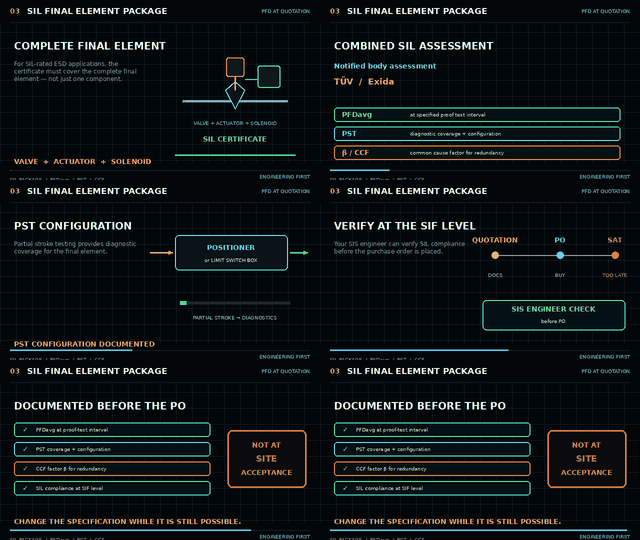
Ensembles de vannes instrumentées SIL 1/2/3 (vanne + actionneur + électrovanne) avec une valeur PFDavg combinée pour l'ensemble de l'élément final. La configuration et le taux de couverture du test de course partielle (PST) sont documentés. Un certificat SIL, délivré par le TÜV ou Exida, est fourni dès l'étape de l'offre commerciale.

Montage ISO 5210/5211 — Coupleur confirmé avant commande

La bride de montage de l'actionneur (ISO 5210 pour mouvement multi-tours / ISO 5211 pour mouvement quart de tour) ainsi que le profil de l'accouplement de tige (carré, rectangulaire ou avec clavette) doivent être vérifiés par rapport au plan de l'interface de montage fourni par le fabricant de la vanne avant toute commande de l'actionneur. Des supports et des accouplements sur mesure sont prévus lorsque le montage selon les normes ISO n'est pas possible.

Types d’actionneurs

Six technologies d’actionneurs. Dimensionnées pour votre vanne. Adaptées à vos exigences en matière de sécurité (mode de repli) et à votre source d’alimentation.
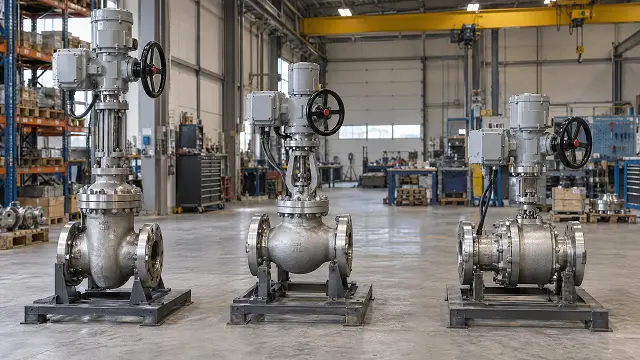
Actionneurs électriques multitours pour robinets-vannes, robinets à soupape et robinets à boisseau sphérique à tige montante.

Actionneur de type 01 — Électrique multitours

Actionneurs électriques multitours pour robinets-vannes, robinets à soupape et robinets à boisseau sphérique à tige montante.

Moteur électrique AC ou DC entraînant un arbre de sortie à plusieurs tours via un réducteur à engrenages droits ou à vis sans fin – pour vannes à guillotine à tige montante, vannes à globe et vannes à boisseau sphérique à plusieurs tours. Commandes intégrées avec commandes d'ouverture/fermeture/arrêt, sélecteur local/distant, interrupteurs de fin de course et de couple, et transmetteur de position (4-20 mA ou potentiomètre). Communication de terrain via HART 7, Foundation Fieldbus ou Profibus PA pour l'intégration au système de contrôle-commande et le diagnostic à distance. Module de batterie de secours pour un fonctionnement sécurisé en cas de coupure de courant. Boîtier en acier inoxydable ou en aluminium avec indice de protection IP67/IP68 pour les installations côtières et offshore. Enregistreur de données mesurant la signature de couple pour la surveillance de l'état de la vanne.
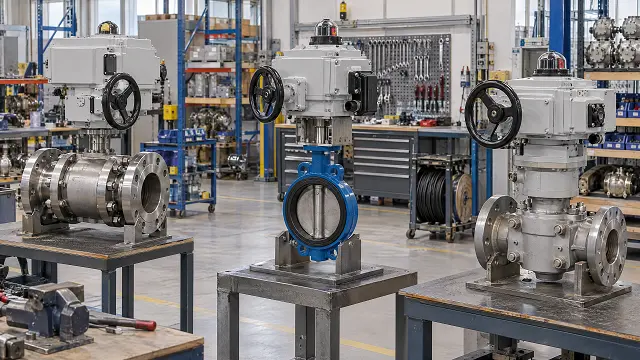
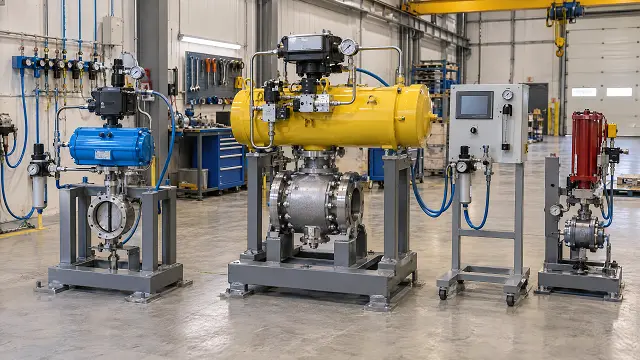
Couple de sortie 10 N·m à 675 000 N·m (selon le réducteur)
Vitesse de sortie 4 à 180 tr/min (réglable via l'option variateur de fréquence)
Alimentation électrique 110/230 V CA monophasé · 380/400/415/440/480 V CA triphasé · 24/48/110/125 V CC
À sécurité intégrée Retour par ressort (bloc ressort) · Secours par batterie · Secours par condensateur pour les faibles puissances
Communication HART 7 · FF H1 · Profibus PA · Modbus RTU · Bluetooth (configuration locale)
Approbation ATEX II 2G Ex d IIB/IIC T4 · IECEx · IP67/IP68 · SIL 2/3 avec redondance
ATEX II 2G IP67/IP68 HART 7 ESD de batterie SIL 2
Our supply standard

Three deliverables on every actuator order that most suppliers ask you to calculate yourself.
Torque sizing calculation — with safety factor — before the PO
01
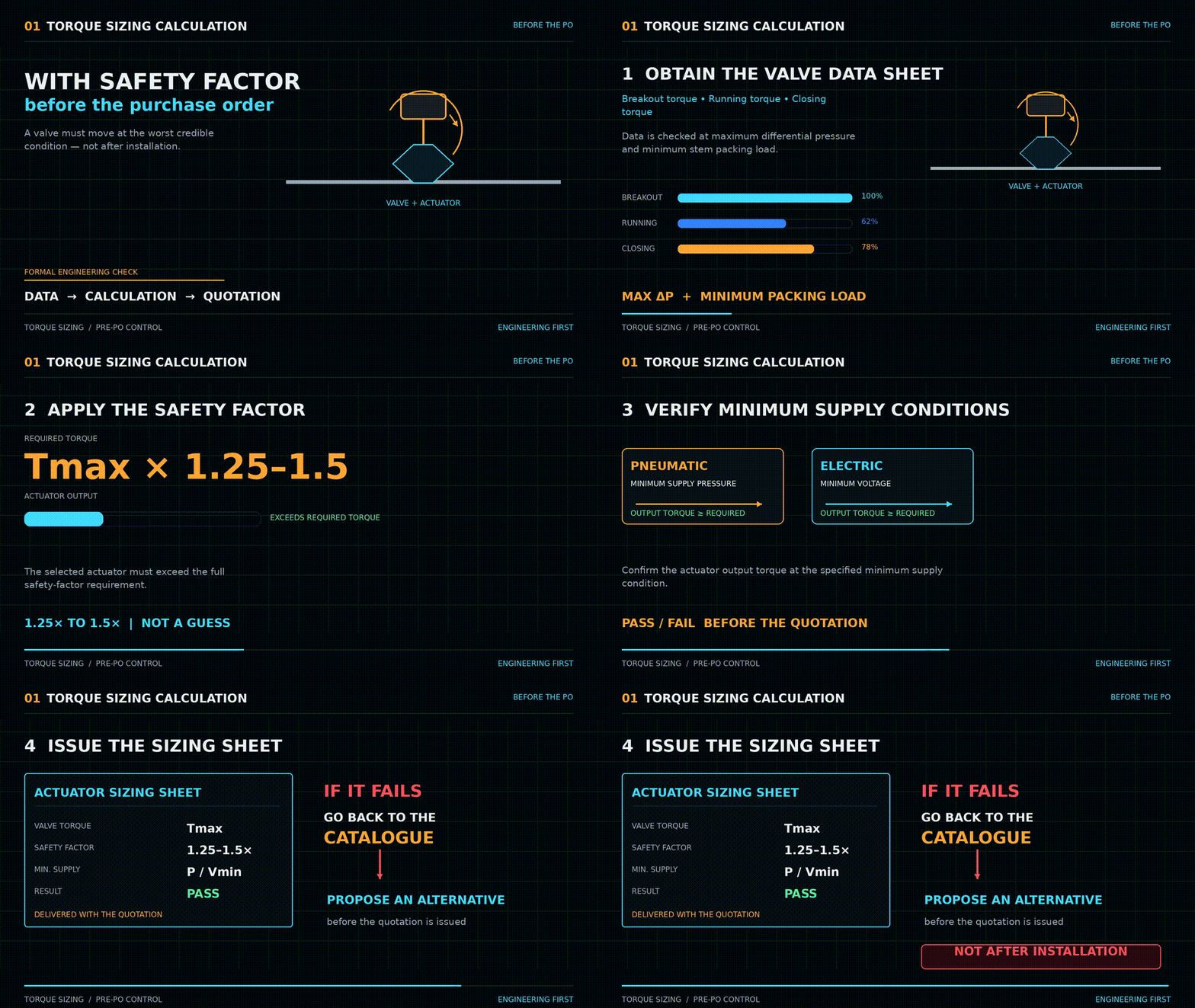
Torque sizing calculation — with safety factor — before the PO

We obtain the valve manufacturer's torque data sheet — covering breakout torque, running torque, and closing torque at maximum differential pressure and minimum stem packing load. We apply a safety factor of 1.25 to 1.5× on the maximum breakout torque (per the actuator manufacturer's sizing methodology) and confirm that the selected actuator output torque, at the specified minimum supply pressure (pneumatic) or minimum voltage (electric), exceeds the required valve torque with the full safety factor applied. This calculation is delivered as a formal one-page sizing sheet with the quotation. If the calculation fails on the first actuator selection, we go back to the catalogue and propose an alternative before the quotation is issued. Not after you install the actuator and find it cannot move the valve.
Min supply pressure Max ΔP condition SF 1.25–1.5×

ESD battery calculation — number of operations at minimum temperature
02
ESD battery calculation — number of operations at minimum temperature

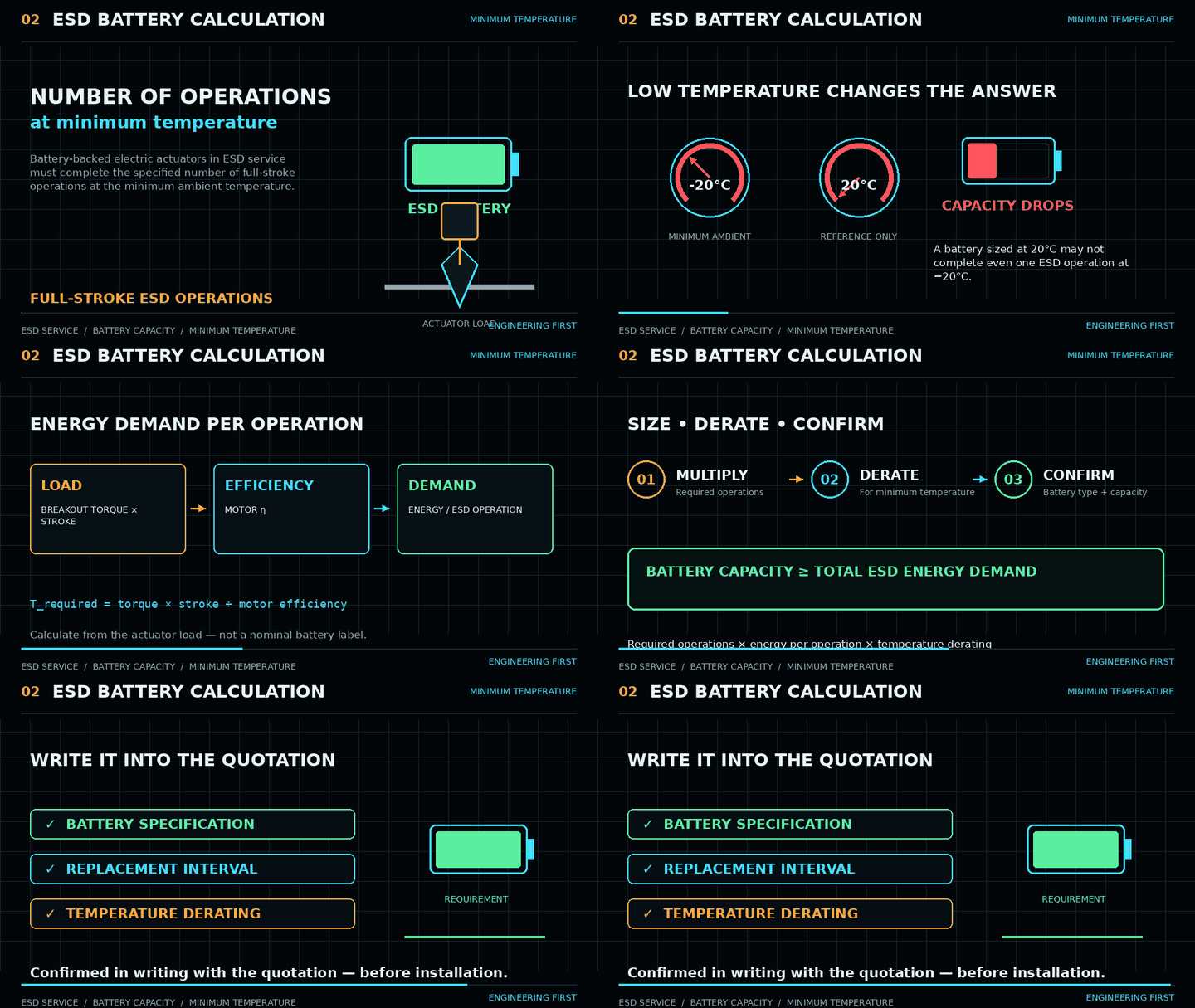
For battery-backed electric actuators in ESD service, the battery capacity must be sufficient to complete the specified number of full-stroke ESD operations at the minimum ambient temperature specified for the installation — because battery capacity decreases significantly at low temperature, and a battery sized at 20°C may not complete even one ESD operation at −20°C. We calculate the energy demand per ESD operation from the actuator's load (valve breakout torque × stroke) and motor efficiency, multiply by the required number of operations, derate for the minimum temperature, and confirm the battery type and capacity that meets the requirement. Battery specification, replacement interval, and temperature derating are confirmed in writing with the quotation.
Per operation energy Temp derating Replacement interval

SIL final element package — PFD at quotation, PST configuration documented
03
SIL final element package — PFD at quotation, PST configuration documented

For SIL-rated ESD applications, the SIL certificate must cover the complete final element — valve, actuator, and solenoid — not just one component. We supply the combined SIL assessment from a notified body (TÜV or Exida) giving the final element PFDavg at the specified proof test interval, the diagnostic coverage achieved by partial stroke testing (PST), the PST configuration for the positioner or limit switch box, and the common cause failure (CCF) factor β for redundant configurations. The SIL documentation is provided at the quotation stage. Your SIS engineer can verify SIL compliance at the Safety Instrumented Function level before the purchase order is placed — not during site acceptance testing when it is too late to change the specification.
TÜV / Exida Final element PFD PST coverage %

Actuator Sizing Process

How we size every actuator — the five-step process we apply to every valve on your line list.

1

Obtain valve torque data

Request valve manufacturer's torque data sheet covering breakout (initial unseating), running, and seating torque at the maximum differential pressure specified for the line. If the valve has already been ordered, we request the data from the valve manufacturer directly or from the end user's project technical authority.
2

Identify worst-case operating condition

For pneumatic actuators: minimum instrument air supply pressure (typically 3.5 bar where normal supply is 5–6 bar). For electric actuators: minimum supply voltage (typically 90% of nominal per IEC 60034). For battery-backed ESD: minimum battery voltage at end of life and minimum ambient temperature.
3

Apply safety factor

Apply safety factor of 1.25–1.5× to the valve maximum breakout torque (the higher value for modulating control valves and critical ESD valves). The safety factor accounts for manufacturing tolerances in both the valve and actuator, and for degradation of the valve packing over time which increases stem friction and breakout torque.
4

Select actuator and confirm output torque

Select the actuator model from the manufacturer's torque table at the identified worst-case supply condition. Confirm that the actuator's rated output torque at the worst-case supply condition equals or exceeds the required valve torque multiplied by the safety factor. For scotch-yoke actuators, verify at both open and close end-of-travel positions.
5

Issue formal sizing calculation

Issue a formal one-page sizing calculation sheet showing: valve tag, valve torque data reference, worst-case supply pressure/voltage, required torque with safety factor, selected actuator model, actuator rated output torque at worst-case supply. Delivered with the commercial quotation for client review before the purchase order is placed.

Why torque sizing matters — the failure mode if you skip it

An actuator that is under-sized for the valve torque will fail to complete its stroke when the valve packing is loaded, the differential pressure is at maximum, or the supply pressure drops below nominal. For an ESD ball valve, this means the valve fails to close in an emergency. For a control valve, it means the process variable cannot be controlled. Both failure modes are preventable by correct sizing. Global Trading provides the sizing calculation as a standard deliverable — not as an optional extra — because the consequences of incorrect sizing are detected too late to correct without cost.

Mounting compatibility — ISO 5211 confirmation before the order

Before the actuator is ordered, we confirm the ISO 5211 mounting flange size (F05 through F40 for quarter-turn) or ISO 5210 stem category (multi-turn) against the valve manufacturer's top-works drawing. The stem coupler profile — square drive, rectangular drive, or round shaft with keyway — is confirmed from the valve dimensional drawing. If the valve does not have an ISO 5211 mounting pad, a custom bracket and coupler are designed, dimensioned, and submitted to the client for approval before fabrication. Bracket and coupler dimensional drawings are issued as part of the actuator package documentation.
Industries & Applications

Actuated valve packages across six industries — each with its own fail-safe requirement and approval framework.

Industry 01
Oil & Gas — Upstream & Pipeline

Wellhead ESD actuated ball valves, pipeline SDV (shutdown valves), and SCSSV (surface-controlled sub-surface safety valves)[cite: 12]. Spring-return pneumatic or gas-over-oil actuators for wellhead ESD where instrument air and power are unavailable[cite: 12]. De-energise-to-trip (DTT) solenoid control with ATEX Zone 1 certification[cite: 12]. SIL 2 rated packages with PST for HIPPS (high-integrity pressure protection systems)[cite: 12].

  • Pneumatic spring-return, DTT solenoid, SIL 2 for wellhead ESD[cite: 12]
  • Gas-over-oil for remote pipeline valves (no instrument air or power)[cite: 12]
  • ATEX II 1G Zone 0 for wellhead zone classification[cite: 12]
  • ESD battery backup for electric actuators in offshore applications[cite: 12]

Industry 02
Refinery & Downstream

Control valve actuators with digital positioners for CDU, VDU, hydrocracker, and HDS unit flow control[cite: 12]. Electric multi-turn actuators for large-bore gate valve remote operation[cite: 12]. SIL 3-rated ESD actuated butterfly valves with redundant solenoid voting (2oo2 DTT) for high-consequence reactor isolation[cite: 12]. Foundation Fieldbus positioners for full digital integration with Honeywell Experion and Emerson DeltaV[cite: 12].

  • FF H1 digital positioners for control valves in DCS-controlled units[cite: 12]
  • SIL 3 ESD packages: 1oo2 solenoid voting, combined PFD documented[cite: 12]
  • Electric multi-turn for gate valve MOV (motor-operated valve) remote control[cite: 12]
  • ATEX Zone 1, stainless enclosure for corrosive atmosphere near process[cite: 12]

Industry 03
LNG & Gas Processing

Cryogenic valve actuators for LNG liquefaction trains and receiving terminals[cite: 12]. Stainless steel enclosures with low-temperature lubricants rated to −60°C ambient[cite: 12]. Spring-return pneumatic actuators for fast-acting BOG (boil-off gas) control valves[cite: 12]. Cryogenic electric actuators with heaters to maintain internal temperature above the minimum lubricant rating[cite: 12]. High-torque scotch-yoke actuators for large-bore cryogenic ball valves (24"–56") in LNG loading arm isolation service[cite: 12].

  • Cryogenic-rated lubricants, −60°C ambient, SS enclosure[cite: 12]
  • Heater provision to maintain actuator internals above −40°C[cite: 12]
  • Scotch-yoke pneumatic for large-bore (24"–56") LNG isolation[cite: 12]
  • Fast-acting spring-return for BOG pressure control (≤5 second close)[cite: 12]

Industry 04
Power Generation

Electric multi-turn actuators for steam turbine bypass valves, boiler feed control, and condenser isolation[cite: 12]. Modulating electric actuators with PID positioner for drum level control globe valves[cite: 12]. ESD electric actuators with UPS/battery backup for fuel gas isolation on gas turbine trip — valve must close within 10 seconds of turbine trip signal[cite: 12]. Weatherproof stainless steel enclosures for cooling tower and outdoor substation gate valve remote operation[cite: 12].

  • Electric multi-turn with VFD for slow-close steam turbine bypass[cite: 12]
  • Battery backup ESD: 10-second close on turbine trip — calculated[cite: 12]
  • Modulating electric with 4–20 mA HART positioner for drum level control[cite: 12]
  • IP68 stainless for outdoor/weather-exposed cooling water valve actuation[cite: 12]

Industry 05
Petrochemical & Chemical

Control valve actuators with digital positioners for reactor feed control, distillation column reflux, and product rundown[cite: 12]. ATEX Zone 1 pneumatic actuators for hazardous area control loops[cite: 12]. GRP (glass-fibre reinforced polymer) enclosures for chlor-alkali and acid environments where aluminium and carbon steel enclosures corrode rapidly[cite: 12]. Diaphragm actuators for hygienic control valves in pharmaceutical and food-grade chemical service[cite: 12].

  • GRP enclosure for Cl₂, HCl, and caustic atmosphere[cite: 12]
  • Profibus PA positioners for Siemens PCS 7-controlled petrochemical units[cite: 12]
  • Diaphragm actuators for hygienic/sanitary control valves[cite: 12]
  • Stainless steel trim and PTFE-lined pilot for corrosive control service[cite: 12]

Industry 06
Water Treatment & Utilities

Electric quarter-turn actuators for remote operation of large-bore butterfly valves in water treatment plants and pumping stations[cite: 12]. IP68-rated waterproof actuators for buried-service gate and butterfly valves in municipal water distribution networks[cite: 12]. Modulating actuators for chlorine dosing control valves[cite: 12]. Non-ATEX rated (safe area) actuators for water treatment facilities where hazardous area classification does not apply, reducing cost without compromising function[cite: 12].

  • IP68 buried-service electric actuators for municipal distribution[cite: 12]
  • Modulating for chlorine dosing and pH control valves[cite: 12]
  • Non-ATEX (safe area) for water treatment — cost-optimised[cite: 12]
  • Bluetooth configuration for hard-to-access installed actuators[cite: 12]

Standards & Certifications

The actuator, mounting, approval, and safety standards confirmed at specification before every order is placed.

🛠️ ACTUATOR & MOUNTING STANDARDS
ISO 5210 Mounting dimensions for multi-turn valve actuators. Stem categories A, B, C, D, E for rising/non-rising stems.
ISO 5211 Mounting dimensions for part-turn (quarter-turn) valve actuators. F05 through F40 flange categories.
EN 15714 Industrial valves — actuator types and operating conditions. Part 1 (electric multi-turn), Part 2 (electric part-turn), Part 3 (pneumatic).
IEC 60529 Degrees of protection provided by enclosures (IP Code). IP54, IP65, IP66, IP67, IP68 per application.
NEMA 4X US equivalent enclosure rating — watertight, dustproof, corrosion-resistant — used on North American specifications.

⚡ HAZARDOUS AREA APPROVAL
ATEX 2014/34 EU directive for equipment in explosive atmospheres. Category 1G (Zone 0), 2G (Zone 1), 3G (Zone 2).
IEC 60079 Explosive atmospheres — equipment design, testing, and marking. IECEx system for international recognition.
Ex d (IIC) Flameproof enclosure — most common protection method for electric actuators in Zone 1. IIC for hydrogen service.
Ex ia (IIC) Intrinsic safety — for solenoid valves and positioners in Zone 0 requiring the highest protection level.
FM / CSA Factory Mutual (FM) and Canadian Standards Association (CSA) approvals for North American specifications.

🛡️ FUNCTIONAL SAFETY & CONTROL
IEC 61511 Functional safety — Safety Instrumented Systems for process industries. Defines SIL requirements for final elements.
IEC 61508 Functional safety of E/E/PE systems. Underlying standard for SIL certification of individual components.
HART 7 IEC 62090 — field communication protocol for positioners and actuators. Device diagnostics from DCS.
IEC 61158 Foundation Fieldbus H1 and Profibus PA — digital field bus for smart positioners and valve controllers.
API 6D Pipeline valves — actuator requirements for ESD ball and gate valves on pipelines per API 6D Annex A.

Actuated valve packages from Istanbul to the Middle East, Central Asia, and Africa — torque-sized, documented, and ready for installation.

40+
Countries
Actuated valve packages exported to 40+ countries from Istanbul since 2001.
5×
Doc Checks
Torque calc · Battery calc · SIL cert · ATEX DoC · ISO 5211 coupler — all confirmed before PO.
SIL3
Max Capability
Final element packages with combined PFD from notified body at quotation stage.
24hr
Quotation + Sizing
Torque calculation returned alongside commercial quotation within 24 hours of inquiry.
Frequently Asked Questions

Questions valve engineers and procurement teams ask before placing their first actuated valve package order.

Documentation — every actuated valve package

Torque sizing calculation with safety factor
ESD battery calculation (battery-backed units)
SIL certificate — final element assembly PFD
ATEX/IECEx Declaration of Conformity
ISO 5211 coupler confirmation drawing
Wiring diagram — DCS to field
PST configuration and coverage %
Functional test certificate
Related Products

Complete the valve automation package from the same supply source.

Valves & Flow Control

Ball, gate, globe, butterfly, check, and PSV to API 6D, API 600, and ASME B16.34. EN 10204 3.1, NACE, ATEX, SIL documentation standard.

Instrumentation & Transmitters

Pressure, temperature, level, flow, and gas detection. HART 7/FF/Profibus PA. SIL 1/2/3. Hookup drawings and loop diagrams per tag.

Rotating Equipment & Pumps

API 610 centrifugal, API 674 triplex, API 675 metering. API 682 seal selection at quotation. Hydraulic duty confirmation included.

NDT & Inspection Equipment

PAUT/TOFD ultrasonic, digital radiographic, MT, ET, PT. ASME V, API 1104, EN ISO. Calibration blocks included with every system.

Submit your valve list for actuation. Torque sizing and quotation returned within 24 hours.

Valve tag · valve type · size · pressure class · end connection · torque data reference (or valve model) · fail-safe requirement (FC/FO/FL) · power supply available · ATEX category · SIL requirement · number of ESD operations · minimum ambient temperature. We size, select, calculate, and quote — with torque calculation delivered alongside the commercial quotation.


Request an Actuator Quotation