Paraffin wax and petroleum jelly with the pharmacopoeia certificate
your application requires — per batch.
Fully refined, semi-refined, food-grade paraffin wax and pharmaceutical-grade petroleum jelly (petrolatum/vaseline) — supplied with FDA 21 CFR 172.886, USP 43, BP 2023, and EU Cosmetics Regulation compliance documentation per production batch, not per product line. Every certificate is batch-specific and traceable.
Batch-specific pharmacopoeia certificates — not generic product conformance statements.
A generic product conformance statement that says "this product meets USP 43" is not a USP 43 certificate — it is a claim. A batch-specific certificate states the actual test values for the batch lot number matching your drums, and is issued by the manufacturer's QC laboratory against the pharmacopoeia monograph. We supply the latter, per shipment.
EU Cosmetics Regulation 1223/2009 Annex II restricts certain polycyclic aromatic hydrocarbons (PAH) in petroleum-derived cosmetic ingredients. We supply paraffin wax and petroleum jelly with PAH testing confirming compliance with the EU limit (<1 mg/kg sum of 8 regulated PAH) for cosmetic applications.
Melting point is confirmed per ASTM D87 (cooling curve) or ISO 2207 for each production batch — not estimated from nominal grade. Congealing point (ASTM D938) also stated for waxes used in formulation. Viscosity (at 100°C, cP) stated for petroleum jelly grades for consistency in formulation.
For Middle East and OIC country markets: Halal certificate from accredited halal certification body on request. For US-bound food-grade paraffin: FDA food facility registration confirmation. Country of origin certificate from chamber of commerce. Kosher certificate available for appropriate grades on request.
Four product categories — each with grade variants, melting point ranges, and pharmacopoeia standards matched to the application.
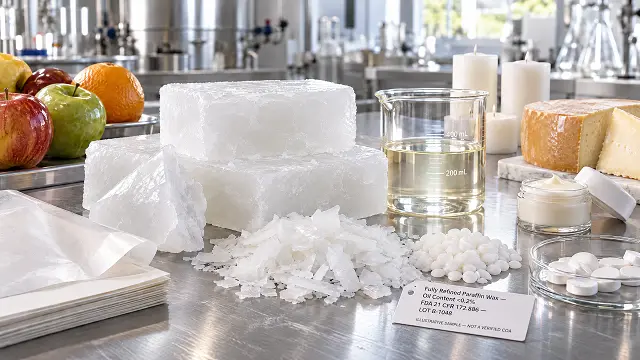
Product 01 — Fully Refined Paraffin Wax
White, odorless paraffin wax with oil content below 0.5% — food contact and pharmacopoeia compliant.
Fully refined paraffin wax is produced by solvent dewaxing and hydrofinishing of slack wax, removing oil to below 0.5% and eliminating aromatic compounds. The result is a white to translucent, odorless wax that meets food contact requirements per FDA 21 CFR 172.886 (USA) and EC 1335/2004 (EU). Applications include food packaging (direct and indirect contact), cheese and fruit coating (cosmetic food-grade wax), candle manufacturing (clean burning, no soot), pharmaceutical coatings and ointments, and cosmetics (lipstick base, creams). Melting point ranges available: 42–44°C, 48–50°C, 52–54°C, 56–58°C, 60–62°C. COA per batch states oil content, melting point (ASTM D87), congealing point (ASTM D938), needle penetration, color (Saybolt), and odor assessment.
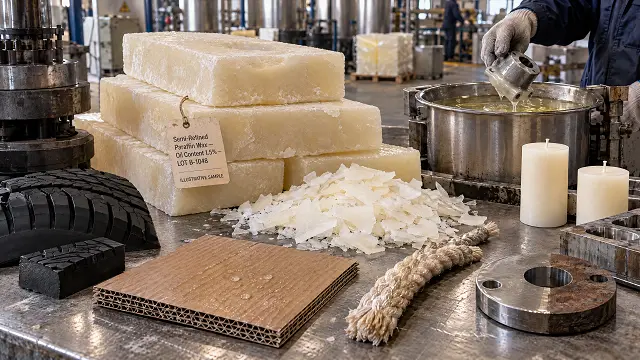
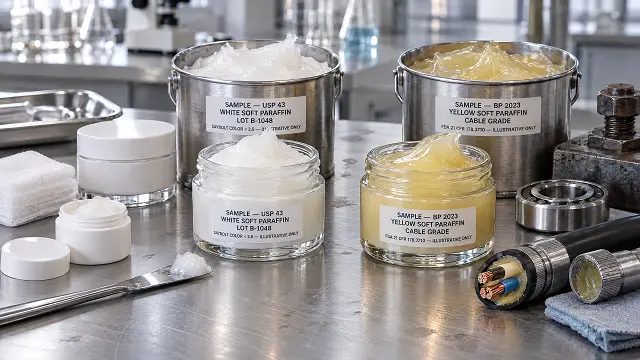
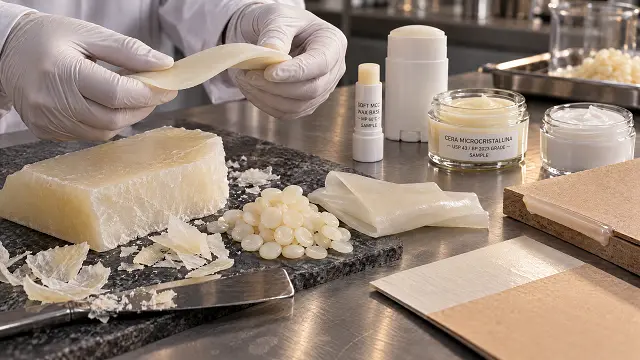
Six application sectors — each with specific grade, melting point, and compliance requirements that we match at quotation.
USP 43 and BP 2023 white petroleum jelly (petrolatum) for topical ointments, wound care preparations, emollient bases, and medical device lubrication. Hard paraffin (BP 2023) for capsule coating and suppository bases. Microcrystalline wax for ointment consistency modification. All with pharmacopoeia CoC per batch, GMP (ISO 22716 or GMP pharmaceutical), and SDS.
White and yellow petroleum jelly, paraffin wax, and microcrystalline wax for cosmetic formulation — lip balm, lipstick, mascara, hair pomade, skin cream, moisturiser, and sunscreen. EU Cosmetics Regulation 1223/2009 compliance with PAH testing below restricted limits. INCI name conformance (PARAFFIN, PETROLATUM, MICROCRYSTALLINE WAX). COA per batch with PAH result.
Fully refined paraffin wax (FDA 21 CFR 172.886) for direct food contact: cheese coating (prevents mould growth on cured cheese), fresh fruit and vegetable coating (fresh produce shine and preservation), corrugated food packaging board water resistance, and food packaging lamination wax. EC 1935/2004 and EU 10/2011 compliance for EU food contact applications. Halal certificate on request.
Paraffin wax is the primary raw material for commercial candle manufacturing. Fully refined paraffin (48–50°C for container candles; 52–54°C for pillar candles; 56–58°C for taper/dipped candles; 60–62°C for night lights) — clean burning, minimal soot. Blends with microcrystalline wax (for adhesion and flexibility) and fragrance load capacity optimisation. COA per batch with oil content and melting point.
Semi-refined paraffin wax as processing aid and antiozonant in rubber compounds (EPDM, NR, SBR) — migrates to the surface and forms a protective layer against ozone cracking in outdoor rubber applications (tyres, seals, conveyor belts, hoses). Board sizing for corrugated carton water resistance. Textile waterproofing. Match manufacturing (stiffens pine wood splint). Rust preventive coating for steel parts in storage.
Petroleum jelly and petroleum wax for cable filling compound (flooding compound for water-blocking in fibre optic and telecommunications cables); LDPE-blended hot-melt filling compounds; cable lubrication during installation; wire rope lubricant (yellow petrolatum base); transformer insulating oil impregnation for paper windings; PCB flux and conformal coating masking. Dielectric and non-corrosive properties confirmed on technical data sheet.
Three compliance facts that separate a batch-specific pharmacopoeia certificate from a generic product claim.
A product that "conforms to USP 43 requirements" (manufacturer's claim) is not the same as a product supplied with a batch-specific Certificate of Conformance to USP 43 (actual analytical data per batch, signed by QC). Pharmaceutical grade petroleum jelly requires the latter — not just because your QA team will ask for it, but because the regulatory obligation to supply a pharmacopoeia-compliant product includes the analytical data to support the conformance claim. Global Trading supplies batch-specific CoC to USP 43 and BP 2023 — with the actual Saybolt color, melting range, and PAH test result for the specific lot delivered to you.
EU Cosmetics Regulation 1223/2009 Annex II (substance Ref. 1086 and Ref. 1087) restricts mineral hydrocarbons of petroleum origin used as cosmetic ingredients, requiring that the sum of 8 specified polycyclic aromatic hydrocarbons (benzo[a]pyrene and equivalent) be below 1 mg/kg. This is tested by IP 346 or equivalent analytical method. Petroleum jelly or paraffin wax supplied for cosmetic formulation without a PAH test result is non-compliant by default — regardless of the supplier's assurance that the product is "cosmetic grade." Every cosmetic-grade paraffin and vaseline order from Global Trading includes a PAH test result per batch confirming the actual value below the EU limit.
For paraffin wax and petroleum jelly in food, pharmaceutical, and cosmetic applications sold in majority-Muslim markets (Middle East, North Africa, Malaysia, Indonesia, and OIC member states), halal certification is increasingly a market requirement — both as a regulatory requirement in some jurisdictions and as a consumer and purchasing preference. Petroleum-derived wax and petrolatum are not inherently non-halal (they are derived from mineral sources, not animal), but the halal certification confirms the absence of cross-contamination with non-halal substances during production and packaging. Global Trading can supply halal-certified paraffin and vaseline grades with certificates from recognised halal certification bodies (JAKIM-equivalent or internationally recognised halal certifiers) on request at the quotation stage.
Questions formulation chemists and procurement teams ask before ordering paraffin wax or petroleum jelly.
Certificates available per batch
Describe your application and required certificates. Quotation with certificate samples within 24 hours.
Product type (paraffin wax / petroleum jelly / microcrystalline wax) · grade (fully refined / semi-refined / food-grade / pharmaceutical / cosmetic) · melting point range · required certificates (FDA/USP/BP/PhEur/Halal) · quantity · packaging preference · destination country. We quote and provide sample certificates within 24 hours.